

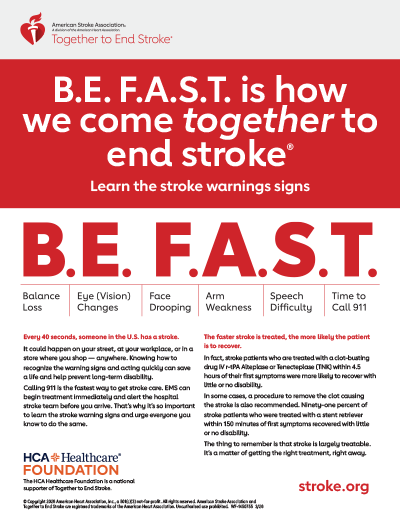
Every year, almost 800,000 Americans suffer from a stroke. This is about 1 person every 40 seconds, and of these people only 10-15% will make a full recovery. If you are able to recognize the symptoms of a stroke and get treatment within 4 hours, you have a significantly higher chance of recovering with full independence which makes quickly recognizing the symptoms of a stroke essential in preventing long term damage. The mnemonic device to remember the symptoms provided by the American Stroke Association is called B.E. F.A.S.T. to help remember the urgency of recognizing these symptoms. Not all symptoms may appear, but it is better to act fast and be safe than take the risk of delaying care.
- Balance – One of the easiest to spot symptoms of a stroke is Balance. Someone who has suffered a stroke may find that they feel like the room is spinning or that they almost feel intoxicated. They also will struggle to stand up straight, walk in a straight line, rely on walls to stay upright, and even lurch to the side due to loss of balance.
- Eyes – Due to optic nerves being blocked, someone suffering a stroke may either see double while both eyes are open or have the eye completely blocked with a gray or black “shadow” that prevents them from seeing. Due to this, the person may also bump into doorframes and objects from the loss of peripheral vision.
- Face – Due to strokes usually affecting half of the brain, the opposite side of the face will be affected. This will be noticeable in the eyes and mouth, with the mouth drooping down on one side and not lifting with the other side in a smile. The person suffering the stroke may also drool from the side affected. With the eyes, you may notice one eye isn’t blinking or is unable to close fully.
- Arm – Like with the face, strokes will affect the opposite half of the body than the half of the brain that had the stoke. The person suffering from the stroke may drop whatever is in their hands. They also will either be unable to raise their arm parallel to the ground, or if they can raise the arm, it will not stay up and instead drift downwards.
- Speech – With speech there are two different things you must look out for. The first is when the person suffering a stroke begins to slur their words and while the sentences are coherent, they’re hard to understand. The second is what’s referred to as “word salad” where they may speak clearly but the sentences are incoherent and make no sense. This can also appear as the person suffering the stroke understanding you but unable to force a response.
- Time – Time to call emergency services. Modern medications and tools that can reverse a stroke, but they must be started within three to four and a half hours after the initial stroke. Every minute the brain goes untreated, up to 1.9 million brain cells can die so the faster they can receive help the more likely a full recovery will occur.
Being one of the leading causes of death for Americans, we should ensure that we are properly knowledgeable about spotting and treating strokes as quickly as possible. By being vigilant we can ensure we can stay healthy and live out our lives with minimal disruptions. When someone makes sure to B.E. F.A.S.T. when spotting a stroke, they are helping save lives.
More information: